Category: Society & Politics

Discussions on politics, policies, and social issues at local and national levels.

  • Trapped Without a Voice: Elevator Safety for DeafBlind Residents

    Trapped Without a Voice: Elevator Safety for DeafBlind Residents

    Surley and I had quite the eventful morning.

    We started off with our usual walk through downtown Minneapolis and along the Loring Greenway. It was a beautiful day. We stretched our legs a little further and wandered through Loring Park. It looks strikingly different without the usual Pride festivities filling every inch.

    Then we crossed the Irene Hixon Whitney pedestrian bridge over Interstate I-94, Hennepin Avenue, and Lyndale Avenue. I stopped to snap a picture of Surley, who was looking particularly dashing in the breeze.

    Surley on the bridge.

    We entered the Sculpture Garden after rolling off of the bridge. This brought on a wave of memories. I remembered the time my Aunt Kate took my sister and me there one summer during a visit. She capped the trip off with Sebastian Joe’s ice cream, which triggered an instant craving. Nostalgia always knows where your sweet tooth lives.

    It had been a few years since I’d been there so I looked up the address on their website. I discovered they had affogato on the menu, espresso over ice cream, and that was it. We were going.

    After a few minor detours thanks to road construction in the area, classic Minnesota summer, we made it. I ordered affogato with chocolate peanut butter ice cream. Unexpectedly bold and delightful. Then I spotted the chocolate chip cookies and, well, you know how that goes.

    Chocolate, peanut butter, espresso is a deliciously dangerous combination.

    Cue: emergency mode.

    So there I was cookie in one hand, affogato in the other, soaking in the calm of a summer morning…

    …and then my phone buzzed.

    “help i am stuck in elevator”

    At first I was a little confused. It was random and out of the blue. I sent a follow up message seeking clarification. When I didn’t get a response, I sent another message. After not hearing back for about five minutes, I started to get worried. This was outside of his normal behavior.

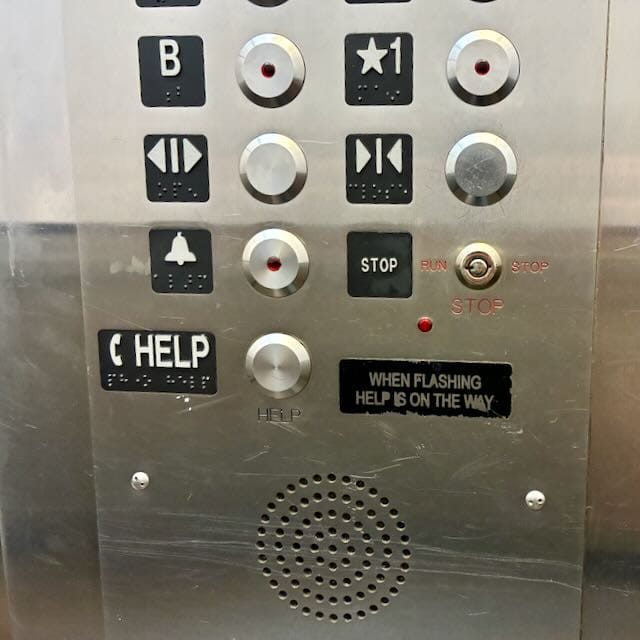
    Jason managed to send another message with a few more details. He was stuck between the basement and first floor of our apartment building, where cell signal was weak. The elevator’s emergency call box was no help—unsurprising, given that he’s Deaf and has low vision.

    He also sent a brief video. From that, I called 911 and explained the situation: a Deaf and low vision person was trapped in an elevator. I let them know the office was closed and no one was answering the phone. Thanks to the video, I could tell the dispatcher exactly which elevator he was in and where it had stopped.

    Quick PSA: Many counties in Minnesota, including Hennepin, support text-to-911. It’s a good choice for folks who can’t speak or hear during emergencies. But not everyone knows it’s available, and it doesn’t always work well underground.

    Once help was on the way, I woke Surley from his nap on the cool tile floor and jogged home.

    Surley napping on the cool tile floor at Sebastian Joe’s.

    Poor Surley, tongue lolling and tail wagging, worked hard to keep pace. He trotted beside me as we walked home at mach 10 like a champ.

    By the time we returned, Jason had just gotten out with help from the fire department. He was headed to the store with a friend. He was okay: hot, sweaty, but safe.

    Afterwards

    Later, we sat down. We talked through everything that had happened. The more I heard, the more disturbing the story became.

    Jason had taken the elevator down to grab some things from his storage unit. When it stopped in the basement, the doors didn’t open. He tried hitting the “door open” button. Nothing. He attempted to go back up to the first floor. He swiped his fob for access to his floor. Still nothing.

    Because of his low vision, he had trouble seeing what floor the elevator thought it was on. There were no audible cues. He pressed the emergency “help” button. He wasn’t sure whether it activated. The indicator was too small and hard to see. He backed up further and got on his knees. Only then was he able to see the blinking red light. He used text-to-speech on his iPhone. He said, “I’m Deaf, stuck in elevator.”

    He also tried live captioning on his phone to transcribe the audio from the speaker. He hoped it would tell him that someone was on the line. No matter where he placed his phone nothing came through clearly enough to be transcribed into words. Even though he is deaf, he can hear static and muffled sounds when using his hearing aids. However, he cannot make out words in detail.

    He stayed surprisingly calm, even though his hands were shaking, which made texting and filming difficult. He immediately noticed somewhat bright yellow light just below the floor display. It was a fire dept override. This reassured him that the fire department was here. It put him at ease that they were working to get him out.

    Eventually, the fire department and an elevator tech arrived and got the doors open. Jason had to step up about a foot to climb out: hot, rattled, and understandably frustrated. But he was, in his own words later, “unfazed.” (Though I think he was being generous with himself.)

    Surley resting in the AC after the day’s events.

    After the dust settled, I spoke with our apartment manager.

    I explained why I called 911. They told me I should’ve left a message on the office line. They assured me they would have responded promptly.

    Now look I get the desire for tenants to follow procedure. But here’s the thing: there was no one in the office. No one answered the phone. The voicemail simply said, “Leave a message for maintenance emergencies.”

    This wasn’t a dripping faucet. A Deaf and low vision resident was stuck in a sealed metal box. There was no clear way for him to call for help. He was starting to overheat. I wasn’t about to wait and hope someone checked their voicemail.

    If I hadn’t answered his text message what would’ve happened? How long would Jason have waited?

    He pushed the “help” button in the elevator. He was using text-to-speech to relay a message. Did the dispatcher realize they were speaking to someone who couldn’t hear them? Was the dispatcher aware of the communication barrier? Did they think it was pressed by accident? Would they have done anything?

    I didn’t want to find out the hard way. So I called 911. And I’d do it again.

    But it raises some real concerns.

    People with disabilities are often left out of emergency planning. Even when the systems are technically in place, they don’t always work when you truly need them. This includes systems like text-to-911 and live captions.

    WWYD (What Would You Do?)

    So, I pose this question to you:

    If you were in my shoes…
    Would you have called 911?
    Would you have left a voicemail and waited?
    Would you have done something else?

    Let me know in the comments. If you live in an apartment building, especially one with older elevators, take a minute. Check what your emergency plan looks like. Talk to your neighbors. Learn your options.

    Because accessibility shouldn’t depend on luck. It shouldn’t hinge on a single person being available to answer a phone. It should be built in — thoughtfully, thoroughly, and proactively.

    Call to Action

    If you didn’t know about text-to-911, now you do. Check your local county’s website to confirm it’s available where you live. Share this post with someone who might not be aware. Accessibility starts with awareness.

    Resources

  • Flying Forward: Let’s Talk About the Flag Controversy

    Flying Forward: Let’s Talk About the Flag Controversy

    A few days ago, the Star Tribune published an article titled “Not a ‘Greater Minnesota’ flag? Detroit Lakes latest city to refuse flying state flag.” It covered the growing number of cities. These cities—including Hastings and Detroit Lakes—are opting not to raise Minnesota’s new state flag.

    I followed the redesign process with cautious optimism. I found the piece frustrating. Not everyone needs to love the new flag. However, so much of the conversation continues to miss the point.

    This is what I had to say in the Star Tribune comments:

    I understand the desire to honor history and the comfort of the familiar. While some believe the previous flag honored our past, others saw it as a symbol of racism. Another fact is the old Minnesota flag was frequently confused with others because it lacked distinction as it was just the state seal on a blue background. I don’t love the new design, and I do think there’s room for improvement, but the old flag wasn’t serving us well. One clear advantage of the new flag is that it can actually be recognized as Minnesota’s something the previous design failed to do. Change is uncomfortable, but it’s also an opportunity. It has given us the ability to have a conversation. If people feel passionately about changing the flag again take the initiative to make it happen.

    A New Emblem for a New Era

    Minnesota’s new state flag was officially adopted on May 11, 2024. It replaced the blue banner bearing the state seal. This banner had flown in one form or another since 1957. Its design lineage goes back to 1893.

    The new flag features a deep blue field symbolizing the night sky. A light blue curve represents Minnesota’s lakes and rivers. An eight-pointed star evokes the state motto, L’Étoile du Nord (“The Star of the North”).

    Looking Back: A Brief History of the Flag

    For the first 35 years of statehood, Minnesota had no official state flag.

    1983

    That changed in 1893 when the Auxiliary Board sponsored the creation of an official flag. The design selected came from Amelia Hyde Center, a Minneapolis artist and leather worker. This original flag featured a white front and blue reverse, which made it expensive and less durable.

    1957

    In 1957, Minnesota redesigned the flag to have a blue field on both sides. This change simplified production. They updated the floral elements for botanical accuracy. They replaced the original moccasin flowers with pink-and-white lady’s slippers. The pink-and-white lady’s slippers are the official state flower.

    1983

    The flag saw another redesign in 1983. Designers lightened the blue. They also updated the seal to include imagery such as the Mississippi River, St. Anthony Falls, and pine trees. This reflects the state’s natural heritage.

    Over time, the 1983 flag drew criticism. It was seen as overly complex and visually confusing. It resembled other state flags that simply feature a seal on a blue background. Critics also raised concerns about the symbolism of the seal, which some viewed as a representation of Manifest Destiny.

    Design Debates and Grassroots Alternatives

    Minnesota’s flag redesign hasn’t been without controversy or creative alternatives. In 1957, Representative John Tracy Anderson and Major General Joseph E. Nelson proposed a star-based flag with red, white, and blue tribands, though it was rejected by the legislature.

    More recently, the North Star Flag was created in 1988 by Lee Herold and Reverend William Becker. It gained grassroots support with its meaningful colors. Its simple and distinctive design also contributed to its popularity. While never officially adopted, the North Star Flag has remained a beloved unofficial symbol. It was even presented to the redesign commission in 2023.

    The Redesign Process

    The push for a new flag gained official momentum starting in 2021. A Wayzata High School student approached State Senator Ann Johnson Stewart with the idea.

    This led to legislation establishing the State Emblems Redesign Commission in 2023. The commission is charged with proposing new designs that reflect Minnesota’s shared history, resources, and diverse communities. It explicitly prohibits symbols that represent only a single group.

    The commission includes representatives from Indigenous, African Heritage, Latino, and Asian-Pacific communities, as well as members of the general public. The commission presented a new flag design after careful deliberation and public input. The legislature adopted this design on May 11, 2024.

    The Refusals and Reactions

    Some People Love It

    As with any change, the new flag has its fans. Many appreciate that the design is clean, modern, and—most importantly—distinctly Minnesota. The new flag doesn’t just look nice on paper. It’s practical and recognizable. It is also far less likely to be confused with any other state’s banner. For decades, people saw a blue flag with a complicated seal. Few could identify it. Now, Minnesota finally has a flag that can stand on its own.

    Some People Don’t

    But of course, not everyone loves the new flag. Some cities, like Detroit Lakes and Hastings, have refused to fly it. Critics often cite nostalgia for the old flag and a desire to honor the past.

    Others see the old flag’s imagery as a reflection of Minnesota’s history. They acknowledge its warts and all. They worry that the new flag erases or sanitizes that story.

    Some also point out that the new flag isn’t perfect and could be improved. And that’s fair—no flag is flawless, and every design involves compromises. The truth is, flags are symbols, and symbols carry different meanings for different people.

    My Take

    I understand the desire to honor history and the comfort of the familiar. While some believe the previous flag honored our past, others saw it as a symbol of racism. Another fact is the old Minnesota flag was frequently confused with others. It lacked distinction because it was just the state seal on a blue background.

    I don’t love the new design. I do think there’s room for improvement. However, the old flag wasn’t serving us well.

    One clear advantage of the new flag is that it can actually be recognized as Minnesota’s. The previous design failed to achieve this. Change is uncomfortable, but it’s also an opportunity. It has given us the ability to have a conversation.

    Flags Aren’t Sacred. They’re Evolving.

    Plenty of iconic flags have undergone change:

    • The U.S. flag has changed 27 times.
    • Canada didn’t adopt its maple leaf until 1965.
    • South Africa’s current flag, widely recognized today, was finalized in days.

    Designs come and go, but the values we attach to them can deepen over time.

    Discomfort is an Invitation

    As I wrote before in my Star Tribune comment:

    “Change is uncomfortable, but it’s also an opportunity. It has given us the ability to have a conversation.”

    Don’t like the flag? Great. Say so. Offer your vision. Start a petition. Participate in the next redesign cycle. But don’t opt out of the conversation entirely.

    Because flags don’t just represent where we’ve been. They shape how we see where we’re going.

    Minnesota is big enough to hold multiple truths. To love parts of the past while acknowledging its harms. To critique a design without discarding what it stands for. To fly a flag that looks forward, not just backward.

    If you don’t feel represented by the new flag—make your voice heard. But don’t assume that refusing to fly it is the same as standing for something noble. Sometimes, progress looks like a banner that’s unfamiliar. Sometimes, unity starts with a little discomfort.

    And sometimes, the bravest thing a flag can do is change.

  • Not a Fan of the Man But Like the Plan

    Not a Fan of the Man But Like the Plan

    Why Elon Musk’s “America Party” Could Shake Up U.S. Politics

    I am a big fan of Elon Musk. Let’s just get that out of the way up front.

    His contributions and support in the past of President Trump have been problematic. His handling of public infrastructure and social programs has also caused concern.

    Additionally, he casually toys with systems people actually depend on, both in the U.S. and around the world. These actions have done real harm. That’s not a small thing. And it’s part of why I approach anything he does with a healthy dose of skepticism.

    But then he threw a wrench into American politics yesterday by announcing his new America Party. Whether you love him or hate him, you have to admit it’s a bold move. Even if you mostly just wish he’d stay in his lane, it’s a bold move. One that’s already sparking debate, and it’s definitely got me thinking too.

    I may not be a fan of the man, but I like the plan. It’s not his plan specifically, at least not yet. It’s the bigger idea.

    This country deserves more than two political parties playing tug-of-war with our future. This moment prompted me to reflect on our history. I considered the role third parties have played in shaping American democracy. They could still play an important part.

    We Weren’t Always Just Red and Blue

    American political history has always been a bit messier than the red-vs-blue binary we’ve come to expect. The U.S. used to have vibrant (and sometimes downright bizarre) political alternatives. Some shaped the nation. Others burned fast and weird.

    Here’s a quick tour through notable political parties that once stirred the pot:

    Party NameYears ActiveNotable For
    Federalist Party1790s–1820sThe original pro-central government party; Hamilton’s legacy.
    Democratic-Republican Party1790s–1820sJefferson and Madison’s vision; states’ rights-focused.
    Whig Party1830s–1850sAnti-Jackson coalition; produced four presidents.
    Know-Nothing Party1850sNativist, anti-immigration movement.
    Free Soil Party1848–1854Opposed slavery’s expansion.
    Progressive Party (Bull Moose)1912Teddy Roosevelt’s breakaway reform movement.
    Socialist Party of AmericaEarly 1900sPushed labor rights; Debs ran for president from prison.
    States’ Rights Democratic Party (Dixiecrats)1948Segregationist Southern breakaway group.
    American Independent Party1968–presentGeorge Wallace’s ultra-conservative party.
    Reform Party1995–presentRoss Perot’s fiscally conservative, anti-corruption effort.
    Green Party1984–presentEnvironment, peace, and social justice.
    Libertarian Party1971–presentSmall government, civil liberties, and personal freedom.

    Want to go deeper? Full list on Wikipedia

    What Elon Musk Just Did

    As reported by The Guardian, Fox News, and CNBC:

    • Musk launched the America Party via X (formerly Twitter), saying it would reclaim power for the people.
    • Framed it as a response to the “uniparty” — a dig at both Democrats and Republicans.
    • Criticized Trump’s $3.3 trillion spending bill.
    • Declared he would target 2–3 Senate seats and 8–10 House seats, not the presidency (yet).
    • Claimed the party would represent the “80% in the middle.”
    • A poll on X showed 65% support — but no voter verification.

    Why a Third Party Could Be a Good Thing

    • Centrists feel homeless. Millions of voters don’t feel represented by either major party.
    • Accountability improves. A strong third voice can hold both sides in check.
    • Elections could get real. Ranked-choice voting and open primaries could gain traction.
    • New ideas. Politics could become about solutions, not just brand loyalty.

    But… There Are Some Big Problems

    • Ballot access nightmares. Every state has its own rules and deadlines.
    • No ground game. Musk has no party infrastructure or grassroots support.
    • Spoiler effect. Could split votes and backfire — especially in tight races.
    • Brand confusion. What does the “America Party” even stand for?

    Even If It Fails, It Sends a Message

    If nothing else, the America Party proves there’s a real hunger for something new. Maybe Musk’s version fizzles — but maybe it opens the door for better third-party efforts in the future.

    Perhaps it encourages changes to ballot access laws. These changes would help minority parties, such as the Green and Libertarian Parties, gain access to local, state, and federal races.

    More choices.
    More voices.
    More ideas.
    More democracy.

    Join the Conversation

    Where do you stand on this? I want to hear from you:

    • Could a serious third party get your vote?
    • Do you think Musk’s money makes this a real threat or is this just political cosplay?
    • Which defunct party do you wish was still around?
    • If you could create a party what would it’s name be and what would you stand for?

    Drop your thoughts in the comments — I’ll be reading.

    Sources and Further Reading

  • Independence for Whom? Reflecting on the Fourth of July in 2025

    Independence for Whom? Reflecting on the Fourth of July in 2025

    It’s the Fourth of July, 2025. Across the country, grills are sizzling, boats are cruising, and coolers are cracking open. The night skies will soon erupt in fireworks. For most Americans, this holiday means freedom, family, and summer fun.

    But I’ve gotten older. Our country has grown louder, more divided, and frankly, more dangerous. And lately, a question keeps echoing in my mind: What does the Fourth of July really mean anymore?

    A Brief History of Independence

    Let’s start with what this day is supposed to commemorate. On July 4, 1776, the Continental Congress adopted the Declaration of Independence. This bold move declared the thirteen colonies free from British rule. It rejected tyranny and laid the foundation for a self-governed nation.

    We still cling to the ideals of life, liberty, and the pursuit of happiness. But here’s the truth: those rights weren’t originally meant for everyone.

    A Revolution That Wasn’t for Everyone

    The Founding Fathers declared that “all men are created equal” while holding others in chains. The government claimed to defend liberty. Yet, it stole land from Indigenous people. It silenced women. It also excluded poor, disabled, and queer individuals from public life.

    In reality, the revolution granted freedom only to a privileged few.

    The story of America since 1776 has been long and painful. It shows a struggle to expand that freedom. The aim has been to include the people left out. The abolition of slavery was not handed down. Women’s suffrage and the Civil Rights Movement were not freely given. The Stonewall Riots and the Americans with Disabilities Act were claimed through struggle. People fought for them alongside those who rose up.

    They were won by those who refused to be erased.

    I write and advocate from within the LGBTQIA and disability communities. For many of us, the fight still isn’t over.

    The Ongoing Attacks on LGBTQ+ Rights…Especially Trans Youth

    Across the country, we’re seeing a coordinated assault on LGBTQ+ rights, particularly targeting transgender individuals. And it’s not happening in shadows—it’s happening in full public view.

    Much of this legislation focuses on minors, stripping away access to gender-affirming care under the false banner of “protection.” But let’s be honest: this isn’t about safety. It’s about political control. It’s about fear. It’s about forcing children to live in bodies and identities that cause them pain.

    Most trans youth seeking care are not undergoing surgeries. They’re being prescribed puberty blockers—safe, reversible treatments that offer something simple and profound: time. Time to think, to grow, to become.

    Instead of trusting doctors or supporting parents, lawmakers are imposing one-size-fits-all mandates on children they’ve never met.

    What happened to freedom?
    What happened to parental rights?
    What happened to that “small government” so many once held sacred?

    35 Years Since the ADA

    This year marks 35 years since the Americans with Disabilities Act was signed into law. It’s a landmark civil rights achievement that changed the legal landscape for millions. I was just finishing kindergarten in 1990. I had no idea then how deeply the ADA would shape my path—or how far we’d still have to go.

    Because the fight didn’t end in 1990.

    If you need a refresher on how we got here, here’s a brief history of the ADA. It still matters. A lot.

    As someone who belongs to both the disabled and LGBTQ+ communities, these issues aren’t abstract to me. They’re personal. They’re real. They’re urgent.

    Even with the ADA in place, accessibility remains inconsistent. Healthcare is broken. Now, under the current Trump administration, programs that support disabled people are under attack.

    These aren’t luxuries. They’re lifelines.

    Today, crucial programs for people with disabilities face funding cuts. Leaders are trying to balance the books. This comes after giving massive tax breaks to billionaires and corporations. Their choice? Slash services for the most vulnerable among us.

    What We Teach And What We Erase

    We say we value freedom, but we whitewash our history to make it more comfortable.

    We teach about the Declaration of Independence. We give a brief nod to the Civil Rights Movement. But what about the Stonewall riots? What about the 504 Sit-In, where disabled activists occupied a federal building for nearly a month?

    Why do we erase the truths that make us uncomfortable?

    Some states are now passing laws that allow parents to pull their kids from school activities that mention LGBTQ+ families. A picture book about two dads becomes “controversial.”

    Look—I support the right of families to hold personal beliefs. I also believe education should prepare kids for the real world. It’s a world full of diverse people, relationships, and identities.

    Pretending they don’t exist doesn’t protect kids. It confuses them. It primes them to respond with fear—or hate—when they meet someone different.

    Independence in a Nation Built by Immigrants

    We are a nation of immigrants. But you wouldn’t know it from today’s political discourse.

    Let me be clear: I support deporting people who commit serious crimes after entering illegally. That’s not controversial—it’s common sense.

    But millions of immigrants—many undocumented—are holding up the scaffolding of our daily lives. They’re working in fields, hotels, kitchens, janitorial services. Jobs many Americans scorn—while depending on them.

    And instead of treating these workers with dignity, we vilify them. We build walls and cages. We pass policies that dehumanize.

    Meanwhile, billionaires and corporations are shielded from taxes, oversight, and even basic accountability.

    The Boiling Pot We Refuse to Notice

    The average American is being played.

    We’re told to fear immigrants. Disabled people. Trans youth. Anyone “different.” We argue among ourselves. Meanwhile, lawmakers pass legislation that benefits the ultra-wealthy and large corporations. This leaves the rest of us scrambling.

    Social safety nets are unraveling.
    Corporate profits are protected, while food assistance, Medicaid, and disability programs are slashed.

    It’s like the old frog metaphor:
    If you slowly turn up the heat, the frog won’t notice it’s boiling.

    That’s where we are as a country.
    And the water’s getting hotter.

    Final Thoughts

    So what does the Fourth of July mean anymore?

    For me, it’s not fireworks or flags. It’s the chance to remember that the dream of freedom isn’t finished. It’s unfinished business.

    The work of building a more inclusive, just, and fair country belongs to us now.

    Not just today—but every day.

  • From Poster Child to Invisible Adult

    From Poster Child to Invisible Adult

    Growing Up Disabled in a World Obsessed with Cute

    When I was a kid, people thought I was adorable. I had chubby cheeks, a bright smile, and Cerebral Palsy.

    That last part, my disability, somehow made me even more “inspiring” in the eyes of strangers. I was the kind of kid who showed up in brochures for community events. I got extra attention from teachers and therapists. I drew “Aww”s and “God bless him”s at the grocery store.

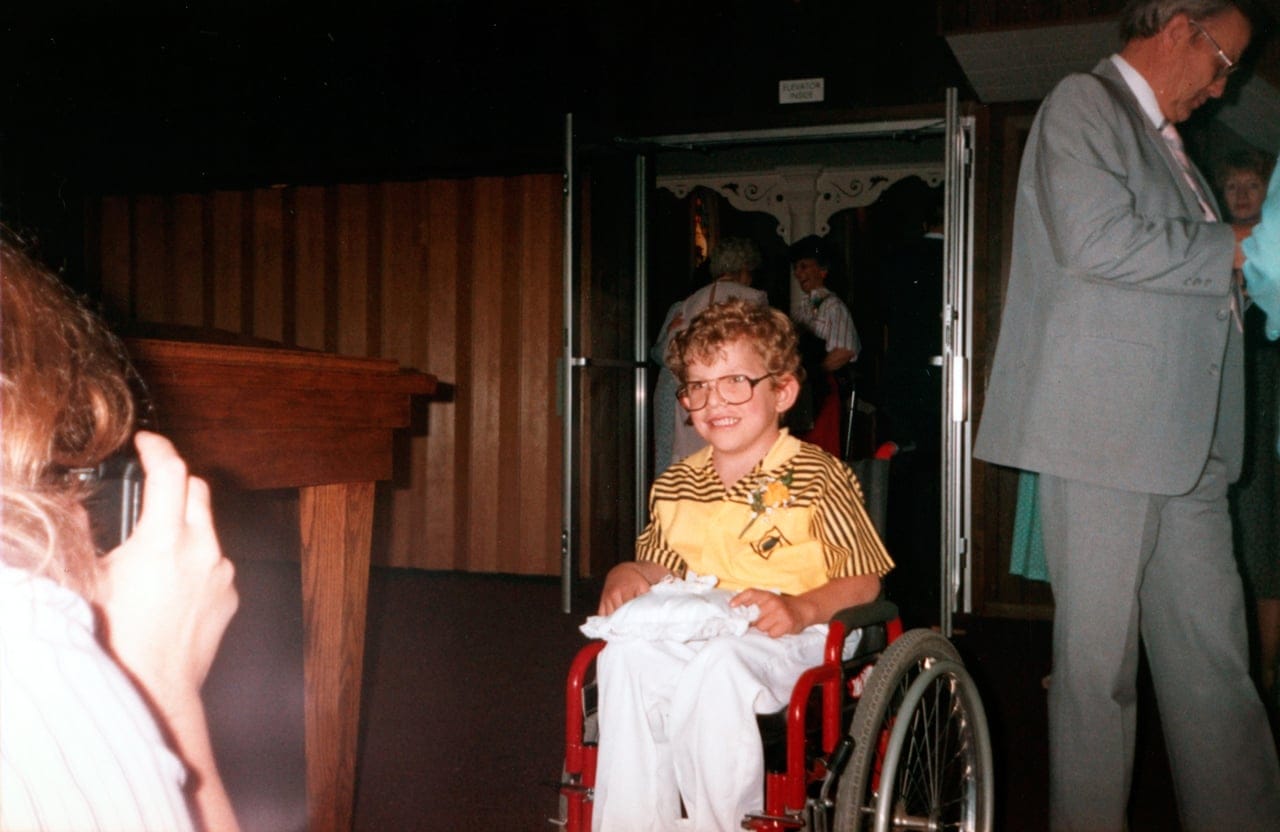
    A young boy with curly hair and large glasses smiling brightly at the camera, wearing a yellow and black striped collared shirt with a yellow boutonnière pinned to it.
    Me at my most joyful—missing teeth, oversized glasses, and a smile bigger than my face. The kind of photo people loved to “aww” over.

    Disabled kids are cute. Society loves a feel-good story, especially one that comes in a pint-sized package with leg braces and a cheeky grin.

    But here’s the thing: I grew up.

    And when I did, the attention disappeared.

    I’m 41 now. Still disabled. Still Cerebral Palsy. Still me. But somewhere along the way, I stopped being cute. And in the eyes of the world, I stopped being seen.

    The same person you saw in the childhood photos. Different glasses, different decade. Same Cerebral Palsy. Same me.

    The “Cute Factor” and Conditional Compassion

    We follow a cultural script with disabled kids. We shower them with support, attention, and affection. This continues as long as they remain children. The moment they grow into adulthood, that same compassion starts to dry up. Public programs disappear. Services shrink. Opportunities narrow. Even social attitudes shift from admiration to discomfort, from celebration to suspicion.

    As a child, I had access to therapies, educational supports, and community resources. There were coordinated efforts to help me grow, thrive, and participate. But as I got older, it felt like the message became: Well, good luck now you are on your own.

    I went from being someone people wanted to help… to someone people tried not to make eye contact with.

    The Adult Disability Cliff

    This isn’t just my story. This situation is a systemic reality known in advocacy circles as the services cliff. The support sharply drops off when a disabled person ages out of pediatric care. It also decreases when they leave school-based programs or children’s nonprofit funding.

    We don’t talk about this enough. Adults with disabilities face higher rates of poverty, unemployment, isolation, and inadequate healthcare. But we rarely make the news unless we’re breaking Paralympic records or fighting for survival in a viral video.

    Why? Because disabled adults don’t make people feel warm and fuzzy in the same way disabled kids do. We complicate the narrative. We ask harder questions. We don’t fit into feel-good stories with easy endings.

    Kids vs. Adults

    As a Child with a DisabilityAs an Adult with a Disability
    School-based physical, occupational, and speech therapyTherapy often not covered or comes with strict insurance limitations
    Individualized Education Plans (IEPs) with legal accountabilityNo IEPs for college or jobs—just ADA “reasonable accommodations”
    Access to special education teachers and support staffLimited access to job coaches; shrinking supported employment resources
    Pediatricians and specialist trained in children with disabilitiesFewer adult physicians familiar with complex disability care
    Early intervention programs (birth–age 3)Virtually no equivalent early adult transition support
    Summer camps, social groups, and extracurricular inclusion programsSocial isolation is common; few adult-focused adaptive recreation spaces
    Case managers to help coordinate servicesAdults often navigate a confusing system alone
    Parent advocates built into the systemAdults are expected to self-advocate
    Medicaid waivers often easier to access for minorsAdult services require complex eligibility and waitlists
    Positive visibility in media and fundraisersAdults rarely portrayed unless overcoming “against all odds”

    The shift is more than inconvenient; it’s structural. We build systems around disabled children to help them grow. Then we tear those systems down just when adulthood starts demanding more from us: jobs, independence, healthcare navigation, stable housing.

    The message? “You’re on your own now.”

    From Three Times a Week to Barely At All

    When I was a kid, I went to physical therapy three times a week.

    I’ll be honest—I wasn’t a huge fan of it at the time. I was a kid. I didn’t want to stretch or do strength exercises. I wanted to be outside or reading or literally anywhere else. But looking back, I realize just how lucky I was.

    Those sessions helped me build strength, coordination, and confidence. They gave me tools to move through the world.

    Now, as an adult? I can count the number of PT sessions I’ve had in the past ten years on both hands.

    It’s not that I stopped needing physical therapy. Cerebral Palsy didn’t magically go away when I turned 18. But getting PT as an adult is a whole different game. There has to be a specific reason or goal that meets insurance criteria. It’s not about maintaining mobility. It’s about justifying the expense.

    Even when you do qualify, you’re often limited to a small number of sessions. Once they’re gone, they’re gone. Never mind if your muscles get tighter again, or if your mobility starts slipping. There’s no regular check-in. No ongoing plan. Just a shrug and off you go.

    I get that insurance companies want to save money. But regular PT for adults isn’t just about recovery it’s about maintenance. It’s about keeping people functioning and independent for as long as possible.

    I’ll be the first to admit it’s not always easy to schedule therapy sessions as an adult. I remember when I was taking classes in Hutchinson. Just finding time between classes and homework to go to PT was a challenge.

    Now, I have to fight for every step literally and figuratively.

    The Economic Angle: Preventative Care Saves Money

    What gets overlooked in all this is how short-sighted the system is. Ongoing PT and accessible health support aren’t just about comfort they’re about prevention. If adults with mobility disabilities had regular maintenance care, many could avoid injuries. Falls, surgeries, and hospital stays could also be avoided later.

    But instead of investing a little now, we let people deteriorate, and then spend far more reacting to preventable problems. It’s penny-wise and pound-foolish. And people like me pay the price with our bodies.

    The Emotional Cost: Losing Visibility

    There’s a strange grief in realizing you once mattered more to the world.

    As a child, I had a whole team cheering me on therapists, teachers, volunteers, neighbors. Now, I’m often just trying to prove I deserve the bare minimum. It’s not just about services. It’s about dignity. About being seen.

    When I was younger, people called me brave. Now, they call me an expense.

    Still Here. Still Worthy.

    I’ve included a photos. Me as a child, me as an adult. The disability in both pictures is the same. The person? Still me.

    But the world doesn’t treat those two versions of me the same way.

    This isn’t a plea for pity or applause. It’s a call to remember that disabled children become disabled adults. We don’t stop needing support, visibility, and respect just because we’ve aged out of a marketing campaign.

    The cute kid didn’t disappear. He just grew up.

    And he still matters.

  • A Revolution Remembered: 250 Years After the Shot Heard ’Round the World

    On April 19, 1775, British troops marched toward Concord to seize weapons. What they found instead was resistance. Ordinary farmers and tradesmen—Minutemen—stood their ground at Lexington. A single shot rang out. No one knows who fired it.

    But that one act of defiance became the spark that lit the American Revolution. That shot, the “shot heard ’round the world,” was not about war—it was about refusal. Refusal to be ruled without representation. Refusal to surrender liberty to unchecked power.

    Two hundred and fifty years later, we are again facing a moment of reckoning. Not with muskets, but with microphones. Not with bayonets, but with ballots and bold voices. The question before us now is the same one our founders asked themselves. Will we allow one person to dictate the future of the many?

    I am a disability advocate. I am deeply invested in civic participation. I’ve spent a lot of time thinking about what real representation looks like. I don’t just study history—I live its consequences. We can see the struggle when navigating inaccessible systems. We also witness it as democratic norms erode in real time. It’s clear that the fight for equity and accountability didn’t end in 1776. In fact, it’s happening right now.

    Today, in 2025, I find myself reflecting on that revolutionary spirit—and wondering how far we’ve strayed from its core principles.

    We now have a President who increasingly behaves as though he alone can decide what’s best for the country. He is circumventing the proper chain of constitutional authority. The office of the presidency is growing disturbingly monarchical. This change is due to sweeping executive orders and claims that other branches are “in the way.”

    What’s worse is that many in Congress, across both parties, are allowing it. The legislative branch should act as a check on power. Instead, it has become largely passive. This passivity enables the President to do whatever he sees fit.

    Even the judicial branch has begun picking and choosing which executive actions to confront, leaving accountability up to political whim. If the courts do rule against the President, there is a growing concern he may simply choose to ignore them. This is because the judiciary, for all its authority, has no enforcement power.

    If the executive no longer respects the rulings of the courts, democracy is not occurring. If the executive fails to adhere to the laws passed by Congress, democracy is not occurring. It is authoritarianism cloaked in American institutions.

    What the Constitution Actually Says

    Our government was deliberately designed to prevent this very kind of power consolidation. The Founders, having just fought a war to escape monarchy, built a system rooted in checks and balances.

    • Article I of the U.S. Constitution gives Congress the power to make laws.
    • Article II outlines the duties of the executive branch, which is to enforce the laws—not to write them.
    • Article III gives the judiciary the power to interpret those laws.

    These three branches are meant to restrain each other, not serve one another. A President may issue executive orders, but those do not carry the same weight as laws passed by the legislature. They are meant to clarify enforcement—not create new legal frameworks.

    The Federalist Papers Warned Us

    Even in the 1780s, the Founders feared the possibility of executive overreach. In Federalist No. 47, James Madison famously wrote:

    “The accumulation of all powers, legislative, executive, and judiciary, in the same hands… may justly be pronounced the very definition of tyranny.”

    And in Federalist No. 51, he reinforced the vital need for institutional limits on power:

    “Ambition must be made to counteract ambition… It may be a reflection on human nature, that such devices should be necessary to control the abuses of government. But what is government itself, but the greatest of all reflections on human nature?”

    These weren’t just lofty ideals. They were warnings from men who had lived under unchecked rule—and refused to let it happen again.

    History Doesn’t Just Repeat—It Responds

    The Revolution wasn’t a one-time event. It was a stand for enduring principles: representative government, accountability, and the rule of law. Every time we allow a single branch—especially the executive—to override or ignore the others, we betray that legacy.

    This isn’t about party lines. It’s about constitutional lines. If we let any President, of any party, expand their authority unchecked, we risk transforming the presidency into something unrecognizable. Something we once fought to be free from.

    Real-World Example: Immigration and the Alien Enemies Act

    The most urgent and alarming example of executive overreach in 2025 is the revival of the Alien Enemies Act. This is an obscure law passed in 1798. It gives the President sweeping powers to detain or deport non-citizens from hostile nations during times of war.

    President Trump’s administration has invoked this law to target and deport Venezuelan migrants. Many of these migrants had legal status, including visas, humanitarian protections, or pending asylum claims.

    The justification? Alleged—but unproven—ties to criminal gangs or national security concerns. In many cases, these individuals were given no warning. No chance to contest the accusations. No hearings. No due process. Just detention and removal.

    The American Civil Liberties Union (ACLU) and immigration advocates have challenged the policy in court. They argue it is a clear violation of the Constitution’s due process guarantees. Even the U.S. Supreme Court temporarily stepped in to block certain deportations.

    The larger concern remains: What if a President can ignore the courts? They could revoke legal visas and strip people of their rights with a signature. What protections are left then?

    This is not just an immigration issue. It’s a constitutional crisis. A President is using a 200+ year-old wartime law to unilaterally remove people. This occurs without oversight, without evidence, and without legal recourse. This action is exactly the kind of authoritarian overreach the Founders feared.

    Personal Reflection & Call to Action

    I advocate for marginalized communities. Rights can quickly be erased when those in power stop listening to the law. They start listening only to themselves. This moment isn’t about politics. It’s about people. And the systems that are supposed to protect them.

    To uphold the integrity of our democratic system, it’s imperative that we, as citizens, engage actively in the political process. This includes:

    • Advocacy: Contacting legislators to express concerns about executive overreach and urging them to assert their constitutional role in policy making.
    • Education: Staying informed about governmental actions and understanding their implications on various communities.
    • Participation: Voting in elections, attending town halls, and participating in public discourse to influence policy decisions.

    We the People Are Still the Safeguard

    We may not be standing on a battlefield. We may not hear the crack of muskets or the gallop of horses. But make no mistake: we are in the midst of a revolution.

    This one may not be started by a single shot—but it can be started by a louder voice.

    A voice that refuses silence. A voice that challenges overreach. A voice that demands the democracy we were promised.

    Our founders lit the fire of liberty with action. We must ensure it keeps burning. This requires awareness, advocacy, and an unwavering insistence that power must always serve the people—not rule them.

    Sources & References

    U.S. Constitution – Full Text: https://constitution.congress.gov/constitution/

    Federalist No. 47 – James Madison: https://guides.loc.gov/federalist-papers/text-41-50#s-lg-box-wrapper-25493412

    Federalist No. 51 – James Madison: https://guides.loc.gov/federalist-papers/text-51-60#s-lg-box-wrapper-25493413

    History.com – Lexington and Concord: https://www.history.com/topics/american-revolution/battles-of-lexington-and-concord

    Vanity Fair – Deportations and the Alien Enemies Act: https://www.vanityfair.com/news/story/supreme-court-blocks-trumps-use-of-wartime-law-for-deportation

  • More Than Qualified, Still Overlooked: One Disabled Worker’s Truth

    The Harsh Reality of Disability and Employment

    Finding a job is hard. Finding one as a person with a disability? Often twice as hard—and half as fair.

    Despite decades of progress, people with disabilities still face enormous hurdles in the workforce. From inaccessible interviews to discrimination that’s harder to prove than to feel, the disability employment gap remains stubbornly wide. As of 2024, only about 22.5% of people with disabilities are employed, compared to 65.8% of non-disabled people, according to the U.S. Bureau of Labor Statistics. And now, with looming threats to Social Security programs, the urgency to find stable, fulfilling work is greater than ever.

    Balancing Purpose and Pay

    I have been looking for more financially stable work for quite some time. I love what I do right now. However, I need something more reliable regarding the amount of money I can bring in.

    I am also looking for jobs that will feed my soul. They should not drain my emotional and physical energy. I know that might seem like taking the easy way out. Throughout my life, I’ve learned that being in draining positions harms my overall well-being.

    Many people with disabilities face the same struggle. They try to balance physical or mental health needs with the demand for financial stability. It’s not just about wanting a job. It’s about finding one that doesn’t push you past your limits.

    A 2022 study by Accenture found a significant correlation. Companies that embraced disability inclusion were twice as likely to outperform their peers in profitability. They also had improved productivity. Yet, many of us never get the chance to show what we can do.

    Living on the Edge of Uncertainty

    I am in a rather unique situation. I do receive SSDI. This allows me to be more selective about the work I do. I am also aware of the changes the current administration is trying to make to Social Security.

    You should look for alternate sources of income. This is important in case there is a stoppage in the SSDI checks you receive. According to the Social Security Administration’s 2024 Trustees Report, the trust fund is projected to be depleted by 2033. Reforms are necessary to avoid depletion.

    The Job Search: A Loop of Silence and Rejection

    In the past six months, I have submitted countless applications. Most of the time, I don’t hear anything back. Then there are rare instances where I get to interview. I don’t know if I suck at the interview process. I don’t know if it’s because I am a wheelchair user. Maybe it’s because I have a service dog. Usually, after that first interview, I get the dreaded response. It says: “After careful consideration, we have decided to move forward with other candidates.” Their experience more closely aligns with our current needs.

    Statistically, this kind of experience isn’t unusual. According to the National Organization on Disability, many employers still have biases. They also have inaccessible workplaces and a lack of inclusive practices. These conditions make it harder for disabled applicants to be hired or promoted. These invisible barriers reinforce the frustrating reality many disabled job seekers face. You can be qualified, capable, and enthusiastic. Yet, you might still be overlooked.

    My Work History: Then and Now

    I have been working on and off since I was 14 years old. During the summer of 1998, I had my first taste of what a job would be like. I was taking summer classes in the Twin Cities thanks to the generosity of my aunts. They had an amazing friend who worked as a head chef at a hotel near the airport. They were willing to give me a chance at what I can now only describe as something of an internship. Arrangements had been made for me to “work” one day a week. Despite this, I still had to interview with the head chef. I was scared and nervous and excited all at the same time.

    My first official summer job was at the Swift County Recorder’s Office in the summer of 2000. It was an exciting experience, even though the job was simple: scanning documents to be digitized. It gave me more responsibility and a little bit of spending money. I worked so much that I burned through the allotted funds that paid my wages. The following summer, I had a similar job with the county’s Soil and Water Conservation Office. Again, it was a simple job but taught me a lot about responsibility.

    These early jobs weren’t glamorous, but they helped shape my work ethic. I was learning to navigate a world. This world was not designed with me in mind, like it wasn’t for many other young adults with disabilities. According to the National Organization on Disability, workplace biases persist. Inaccessible environments remain. Additionally, a lack of inclusive practices continues to be a major roadblock to employment for disabled individuals.

    Campus Jobs, First Steps, and New Lessons

    The summer after my senior year of high school, I didn’t work. Not because I couldn’t get a job, but because I wanted one last summer of freedom before college. During college, I held a few on-campus jobs. While living in Hutchinson, I worked part-time as a tutor. To be honest, I don’t even remember what subject I tutored. However, I do remember getting a letter from the county about not reporting the $65 I earned. I had no idea I needed to at the time.

    At Augsburg, I had a variety of jobs. I helped the campus LGBTQ+ organization with their website and digital advertising. I was also a tour guide for the admissions office. My focus was often giving tours to prospective students with mobility challenges.

    A Decade of Retail—and Then, the Curtain Closed

    After graduation, I was fortunate to land a temp job with a downtown Minneapolis staffing agency. I was surprised they hired me, but I guess when you’re a temp, they take whoever they can get. That role lasted about eight months, and then I was unemployed again. I submitted many applications back then. It felt like a lot. I rarely heard anything back.

    Eventually, I applied at Best Buy. They had a location at the Mall of America. It was easy for me to get to. I’d never worked retail in my life and barely shopped at Best Buy before. I remember the hiring process. There was a phone interview. Then there was a group interview (my first ever). I felt completely out of place during it. I didn’t say much because I didn’t know what to say. Somehow, I said enough to move on to the final interview and land the job.

    Originally, it was supposed to be a seasonal role, but they decided to keep me on part-time after the holidays. I continued working at Best Buy for nearly 10 years. Over time, I shifted into different departments and eventually landed a full-time position. It was nice having PTO and a consistent paycheck.

    Unfortunately, it wasn’t meant to last. In the summer of 2018, Best Buy closed that location. I considered applying to the nearby Richfield store and even had a few interviews there, but it felt different. They seemed more hesitant to hire someone with my “unique abilities.” It didn’t work out, but I received a decent severance package and took a much-needed three-month break.

    That hesitation? It mirrors what many disabled workers experience. Too many hiring processes contain a subtle skepticism. There’s a belief that accommodating a disabled employee is more trouble than it’s worth. But data and my own personal experience contradicts that. Studies show that providing accommodations often costs less than $500, and the long-term benefits—employee retention, morale, and diversity—are invaluable.

    I did a training video in 2017 while I was with Best Buy on this exact issue. My general manager and I were featured in a video about workplace accessibility. The video highlighted how simple accommodations can make a huge difference in supporting disabled employees. These include clear communication, flexibility, and simple adjustments to schedules and the layout of an eight-foot section. For example, the management made the point-of-sale terminal more accessible. This change helped me ring out customers in my department.

    All they had to do was remove a section of shelving to lower the register. It didn’t just work for me—it worked for everyone. While the video is now unlisted, it remains one of the proudest accomplishments of my time there and is still featured on my LinkedIn profile as a reminder of what true inclusion can look like in action

    Where I Am Now—and Where I Want to Go

    In the fall of 2018, I landed my current role at U.S. Bank Stadium. I love the staff I work with—it’s a great environment. Things have changed a lot since returning post-COVID, but I don’t see myself leaving anytime soon. That said, hours have been very limited since the pandemic. I need something that provides more financial stability.

    In 2021, I met Amy B., a personal trainer specializing in inclusive fitness. She created Fit with Amy B to provide training for people of all abilities. I improved my own health through her program. She also brought me on to help behind the scenes making everything run smoothly. She saw the benefit of having people with disabilities not only workout with her. They also worked with her to bring greater awareness to healthy living, regardless of your abilities. I truly loved what I did for Amy. I have yet to find another job that offered the same level of flexibility. It also provided fulfillment.

    Unfortunately, SSDI barely covers my monthly expenses. It doesn’t give me the flexibility to do the things I enjoy, like traveling or going out with friends. Living on a fixed income can be incredibly limiting.

    According to the National Organization on Disability, many people with disabilities face financial insecurity. They also encounter systemic bias and physical barriers. These obstacles prevent equal access to job opportunities.

    And yet, studies by Accenture show that companies prioritizing disability inclusion perform well. They are also twice as likely to be innovative.

    The Bigger Picture: You’re Not Just Hearing My Story

    This isn’t just my story. It’s the story of many people in the disability community. They want to work. They are ready to work. They constantly run into walls—both visible and invisible. It’s time to break those walls down.

    Call to Action

    We need employers, policymakers, and communities to step up. Employers must rethink hiring practices to eliminate bias and prioritize inclusion. Lawmakers need to protect Social Security and invest in programs that support people with disabilities, not strip them away. And for those reading this: listen to our stories. Share them. Advocate for change. Because no one should be shut out of opportunity simply because society hasn’t caught up to our potential.


    Sources:

  • The Cost of Loyalty: What It Takes to Be a Season Ticket Holder

    The Cost of Loyalty: What It Takes to Be a Season Ticket Holder

    I wasn’t planning to write this today. I sit here and look out at the dreary Minnesota sky. I know there’s a significant chance I won’t attend tonight’s Minnesota United FC match. I felt like I needed to put some thoughts down.

    Quick note: I’m part of AccessiLoons—Minnesota United FC’s first and only supporter group focused on accessibility and inclusion. However, everything I share here is based on my personal experience. It doesn’t reflect the views of the group.

    This will be the second game I’ve missed this season—and not because I’ve lost interest or stopped caring. Far from it. I’ve been a season ticket holder since 2015. That was long before the team joined MLS and before Allianz Field was even a blueprint. Supporting this team has been one of the most consistent and joyful parts of my life.

    But tonight, like many nights, I’m forced to weigh the realities of being a fan with a disability. The weather is cold, windy, and there’s a chance of rain or snow. And rain and power chairs don’t mix well.

    After last weekend’s afternoon match, my wheelchair started to malfunction on the way home. Thankfully, I made it back safely and the issue didn’t repeat itself—but moments like that stick with you.

    Every time I head out in this type of weather, there’s that voice in the back of my mind:

    • “Is my chair going to malfunction again?”
    • “Will I get stranded somewhere?”
    • “What do I do if something goes wrong?”

    It makes you cautious at times about leaving the house.

    This post isn’t just about one missed game. It’s about what it really takes to be a loyal fan in 2025—financially, physically, and emotionally.

    When Passion Meets Practicality

    I’ve always budgeted for my season tickets. When I was working full time, the yearly price increases didn’t hit as hard. Even during the pandemic, I had enough money coming in to keep my seats. Soccer was one of the few constants during an unpredictable time.

    But when the world reopened, my income didn’t bounce back as ticket prices continued to rise. Something that once felt like a justifiable splurge now feels like a financial stretch.

    Still, giving them up feels impossible. Supporting this team is part of my identity. It’s how I connect with friends. It’s where I feel community. But loyalty, especially on a fixed or limited income, comes with a price—and that price keeps going up.

    Accessibility Isn’t Just About Seats

    Being a fan with a disability adds another layer to all of this.

    Sometimes, I simply can’t attend—even when I want to. The home opener in March is always a weather gamble, and this year was no exception. That was in the evening—and I had just worked an afternoon shift at U.S. Bank Stadium. I was already cold and running low on energy. I didn’t know if I had the stamina—or the body regulation—to sit through the full match.

    As someone with limited mobility, I can’t generate much body heat. Once the sun goes down, so does the temperature—and so does my ability to safely enjoy the game.

    I made it to the match the weekend before because it was an early afternoon kickoff. It was still cold, but the sun made it manageable. That little bit of warmth made all the difference.

    And then after the issues with my wheelchair after last weeks game there’s the added layer of equipment concerns. It was enough to shake my confidence. Now, every time I head out , I have to ask:

    • What if my chair stops working?
    • What if I get stuck far from home?
    • Who do I call?
    • Will anyone be able to help?

    That kind of risk doesn’t factor into most fans’ decisions to attend a match. For disabled fans, it’s part of the mental math every single time.

    To be clear, many of these challenges aren’t unique to Minnesota United or Allianz Field. The stadium staff has generally been supportive, and there are accessible features in place. But even well-designed venues can fall short when the full spectrum of disability isn’t considered. These issues show up in stadiums across the country—and they’re often invisible to those who don’t live with them.

    Some of the most common barriers disabled fans face include:

    • Cold or extreme temperatures that are dangerous for fans with mobility or circulation limitations.
    • The distances from parking or public transit stops are long. They can feel like a marathon for those with fatigue. This is also true for those with chronic pain.
    • Crowded concourses and bottlenecks that create safety issues for wheelchair users and others needing space.
    • Ticket policies with little flexibility, even when health issues make last-minute changes necessary.
    • Energy management challenges—sometimes, it’s not about willpower. It’s about knowing your body has limits.

    The Marketplace Problem

    When I can’t attend, I turn to the SeatGeek Marketplace to resell my tickets. But that experience isn’t fan-friendly either.

    I need to list the tickets above face value to cover SeatGeek’s 10% seller fee. This is necessary to just break even. On top of that, buyers are charged another 10% fee. That’s a 20% markup just for a resale—not to make a profit, just to avoid losing money. And guess what? Most people won’t pay that.

    So now, I’m out the money, and I missed the game. It adds insult to injury.

    Lately, I’ve found myself quietly wondering what the future holds. I’m not ready to give up my season ticket membership yet. However, I’m starting to reevaluate things. The rising costs, the physical strain, the uncertainty that comes with each game—it all adds up.

    At some point, I may have to ask myself whether this version of loyalty is still sustainable for me. I love this team. I’m not going anywhere as a supporter. However, being a season ticket holder might look different down the road.

    Let’s Do Better—for All Fans

    If you work for a team, a supporter group, or even a ticketing platform, ask yourself a question. What are you doing to make sure disabled fans are fully included?

    Accessibility isn’t just about wheelchair spaces or ADA check boxes. It’s about understanding the full picture. This includes weather risks, energy limits, and malfunctioning mobility equipment. Resale policies also matter. Then, there is the emotional toll of being excluded from something you love.

    If you’re not thinking about all types of access, you’re leaving people behind.

  • Here We Go Again

    I Hate Writing About This, But I Have To

    I don’t like talking about politics on social media, and I certainly don’t like writing about it here. But this isn’t about politics—it’s about livelihood.

    I feel like I’ve written this post a dozen times. I hate that I have to keep writing about government funding, budget cuts, and restructuring. I hate that every few months, I have to sit down and explain. Once again, I must clarify why Social Security, Medicare, and Medicaid aren’t just line items on a budget. They are lifelines for millions of people, including myself.

    I wish I didn’t have to keep writing about this. I won’t stay silent until I am confident that my future is safe. The future of millions of others must also be safe for me to stay silent. Because the moment we stop speaking out, those in power believe they can do whatever they want.

    Why This Matters (Again)

    There’s talk of making deep cuts to Social Security, Medicare, and Medicaid. Do I think it’ll happen? Maybe not to the extent being proposed, but the fact that it’s even a possibility is terrifying. Medicaid/Medicare is a life line for people like me.

    If it does happen, here’s what it means for me:

    • SSDI helps cover my portion of household bills and the costs of having a service dog. I work part-time, but last year, I made about $1,600 before taxes—not nearly enough to live on.
    • Medicare covers my $50,000 power wheelchair. If they slash funding, approvals for equipment and repairs could take months. If my chair breaks down, my independence is gone.
    • Medicare and Medicaid cover my PCA (Personal Care Assistant) hours. These hours help me conserve energy. This way, I can focus on things that bring me joy. Examples of these activities are writing and spending time with friends. If they take those hours away, I risk serious health consequences. Even a reduction means needing a shoulder replacement sooner rather than later.

    And then there’s Jason, my longtime PCA, who also relies on this income. If his hours are cut, he loses a major source of financial stability. That means losing our home. It’s that simple.

    This isn’t just about me. This is about millions of people—seniors, disabled folks, low-income families—who depend on these programs to survive.

    In a recent Disability Scoop post dated March 19, 2025, they tell the story of Xavier. He has a rare genetic immune disorder. It undermines his body’s ability to fight disease. California’s Medicaid program, Medi-Cal, provides Xavier with the treatments he needs. It offers resources to his family as well. This support helps him live as normal of a life as possible.

    His mother is quoted saying:

    “It’s allowed him to go to school. It’s allowed him to be home and not living in a hospital 24 hours a day,”

    Parents of children with special health care needs aren’t the only ones raising concerns about potential cuts. Disability advocates, health care providers, budget analysts, and state lawmakers have also voiced alarm. The House proposal passed on February 25 does not explicitly call for Medicaid cuts.

    Nonetheless, it instructs the House Energy and Commerce Committee. This committee oversees the program. It needs to find $880 billion in savings over the next decade. According to experts, reaching that level of savings would be nearly impossible without reducing Medicaid funding.

    I Hate Writing About This, But I Can’t Stop

    Every time I write about Social Security or Medicare or government cuts, I feel like a broken record. I’ve covered this before:

    And yet, here we are again.

    I wish I could stop writing about this. I wish I could move on. But I can’t. The second we stop talking about it, the people in power win. The moment we get exhausted and say “Oh well, nothing we can do,” they triumph.

    What Can We Do?

    • Talk about it.
      • Even if it feels repetitive, even if it’s exhausting—keep the conversation going.
    • Contact your legislators.
      • I know, I know—Congress is a mess. But if enough of us make noise, they have to listen.
    • Get your story out there.
      • Talk to the media.
      • Write to local newspapers.
      • Use social media.

    I don’t want to write another post like this in six days, in six weeks, or in six months. But if I have to, I will.

    Because this isn’t politics. This is life.

    Read More:

  • Left Behind by the Democrats

    Left Behind by the Democrats

    Over the past few months, I’ve written extensively about the changes unfolding in our government. I’ve also discussed their impact on our communities.

    There have been drastic budget cuts to Social Security. There is also an urgent need for reform in Minnesota’s disability services. I’ve delved into the pressing issues that affect us all. I’ve also explored the challenges faced by the LGBTQIA+ community, highlighting the growing need for advocacy and support.

    Amid these discussions, I’ve felt an increasing urge to share more of my personal story. Shortly after the 2024 presidential election, I wrote a piece that I wasn’t quite ready to publish. It was raw, emotional, and an honest reflection on feeling left behind by the Democratic Party. While I shared it with a few close friends, I hesitated to make it public. I wasn’t sure how it would be received—and, frankly, I wasn’t ready for the potential backlash.

    I continue writing about the state of our nation and the impacts of policy changes on disability support services. I realize that my personal story is an essential part of this broader conversation.

    The emotions I felt in November 2024 still resonate. They affect not just me but many others too. These emotions reach those who feel disconnected, disillusioned, and left behind.

    Today, I’m ready to share this piece with you. I’ve made some edits to improve readability and included links to cited sources. My hope is that it resonates with you. I wish it sparks meaningful conversations. I also hope it encourages all of us to think critically about the direction we’re headed as a country.


    Left Behind by the Democrats

    A Personal Reflection on the Democratic Party’s Disconnect and the Fight for Our Rights

    By Levi Dokken | November 7, 2024

    I have been sitting here with a lot of feelings—sadness, anger, even rage. Part of me wanted to lash out at the people who voted for Donald Trump. To work through these emotions, I felt the need to sit down and write.

    Writing helps me release emotions. It allows me to express my thoughts. By expressing them, they don’t consume me.

    The Disconnect Between the Democratic Party and Rural America

    Donald Trump has won, and I believe it’s because the Democrats failed. They have failed the people they claim to represent. They are no longer the party of working men and women. Just look at the state of Minnesota. It went for Harris but is still a sea of red. There is only a small island of blue. The party only focuses on the areas where they need electoral votes to win the overall race.

    I grew up in a small town in Minnesota. I saw firsthand that most people in my community weren’t necessarily concerned with national politics.

    They focused more on day-to-day struggles. They were figuring out how to put food on the table. They were also finding money to cover the mortgage. They worried about what to do if their child needed braces and health insurance didn’t cover it.

    Candidates campaigned across the United States. They focused primarily on so-called battleground states and urban areas. They believed these areas would secure enough votes for them.

    Small towns across the nation increasingly feel disconnected from the Democratic Party. They believe the party has shifted its focus toward urban and coastal issues. This shift comes at the expense of rural communities.

    The Electoral System: A Barrier to Representation

    I often wonder if political candidates would pay more attention to smaller towns if votes were delegated differently. They might also focus on smaller states.

    Our current electoral system feels outdated. It resembles a relic of an age long since dead. In it, the voices of a few battleground states dictate the direction of the entire country.

    What if we had a more localized electoral college system within each state?

    For example, if each county were assigned an electoral vote, it might create a more balanced representation. The majority vote within a county would decide how that county’s electoral vote was cast. This system could offer an option to the current popular vote system that most states use to assign their delegates.

    Disappointment with Democratic Leadership

    Joe Biden announced he was running for a second term. I had a strong feeling he was going to lose.

    In 2020, he claimed he would be a transitional president. What happened to that promise? He was unwilling to even hold a primary. I was much more enthusiastic about the possibility of MN Rep. Dean Phillips entering the race. The Democrats, however, dismissed it, holding fast to the tradition that the incumbent automatically runs for re-election.

    Watching the first presidential debate, I was floored. Both candidates seemed unfit to hold the highest office in the land.

    Biden stumbled with his words and thoughts; at times, he seemed unable to keep his ideas in order. Trump wasn’t much better—he mostly rehashed grievances from 2020 without offering a clear plan for change.

    Project 2025: A Threat to Disability Rights

    Project 2025 adds to my concern. It is a plan from The Heritage Foundation. The next administration might choose to implement it.

    According to the Disability Rights Education & Defense Fund, this plan proposes changes with deep impacts on programs like Medicaid. It introduces funding caps, stricter eligibility requirements, and time limits.

    These changes could drastically reduce access to essential services for people with disabilities. Services like medical equipment, personal care attendants (PCAs), and specialist visits are crucial. They are necessary for maintaining health and independence.

    For me, Medicaid covers my specialist visits. It also covers my nearly $50,000 power wheelchair and repairs. Additionally, it covers the cost of my partner, Jason, as my PCA.

    How Do We Talk to Those Who Voted for Trump?

    How do I talk to my friends and family who voted for Donald Trump? How do I understand their choice to support someone who has assaulted women? He attempted to overturn a fair election. He also incited his supporters to storm the Capitol.

    Some of Trump’s supporters hold harmful views. However, I believe most are simply scared, misinformed, or longing for a past they believe he can bring back.

    I don’t want to cut these people out of my life, especially when many are lifelong friends or family. We can still be connected; we just may not talk about politics.

    What Can I Do Moving Forward?

    I’ve shared many things with you. The Democratic Party’s disconnect from rural America is concerning. Our electoral system has flaws. Policies like Project 2025 carry potential consequences. There’s a growing divide among friends and family. I can’t help but feel a mix of frustration and overwhelm.

    The future feels uncertain. These decisions could have long-lasting effects. They could also have life-changing effects for myself and those I care about. I find myself sitting here after writing this, asking myself, What can I do?

    As one voice out of millions, not much. But I can be part of something bigger. When others raise their voices against the incoming administration’s policies, I can stand with them. I can support the women in my life, the friends who feel vulnerable right now. I can do my part, however small, to work toward a future that protects everyone’s rights and dignity.

    Will you join me?


    Sources